
It’s 2 a.m. when the property manager gets the call: a burst pipe on the 14th floor has flooded three apartments below it, water is running down the fire escape stairwell, and the building’s main electrical panel has tripped. The owners’ committee assumes the building’s insurance policy will handle it — after all, they pay the premium every year without much thought. But when the claim is filed, they learn that some of the damage is covered, some falls into a grey area, and some isn’t covered at all. This is one of the most common — and most expensive — surprises building owners and management companies face in the UAE, and it usually comes down to one thing: not knowing exactly what the policy covers before something goes wrong.
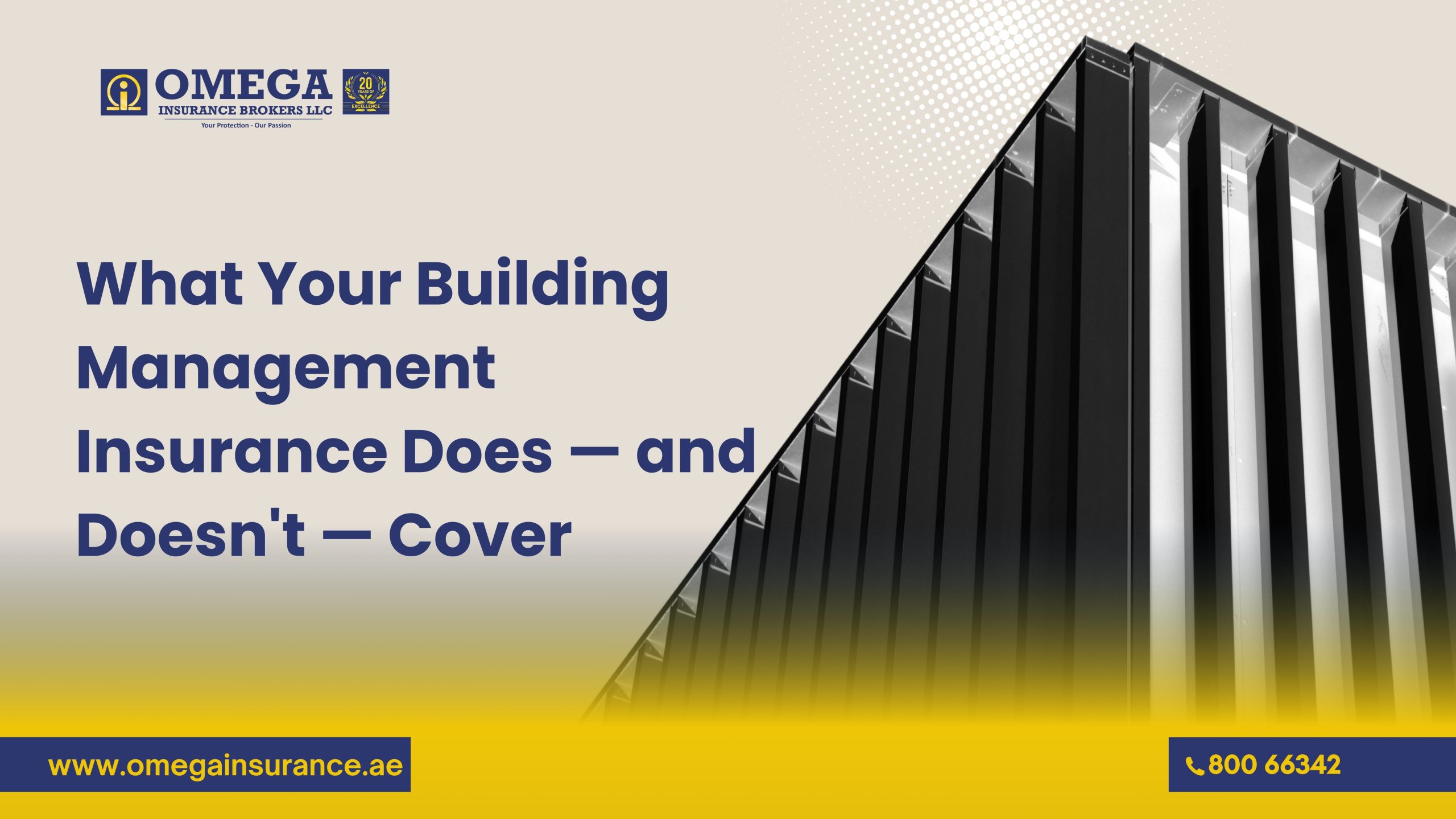
What Building Management Insurance Actually Is
Building Management Insurance (sometimes called Owners’ Association or Master Community insurance) is a policy taken out by a building’s management company, owners’ committee, or master developer to protect the shared structure and common areas of a property — as opposed to the individual units inside it. In the UAE, this is often a requirement under community management regulations (such as RERA’s Jointly Owned Property rules in Dubai), since someone has to be responsible for insuring the building envelope, shared systems, and communal spaces that no single owner controls on their own.
It typically sits alongside — but separately from — the individual home or contents insurance each unit owner or tenant may hold for their own apartment or office.
What It Typically Covers
- The building structure. The external walls, roof, foundations, and common structural elements are usually covered against fire, storm damage, and other insured perils.
- Common areas and shared facilities. Lobbies, corridors, stairwells, parking areas, gyms, pools, and landscaped areas are generally included, along with the fixtures within them.
- Shared building systems. Central plant such as elevators, fire alarm systems, HVAC systems, generators, and water pumps serving the whole building are typically insured, subject to the policy’s schedule.
- Public liability. Most policies include third-party liability cover, protecting the owners’ association or management company if someone is injured in a common area, such as a slip on a wet lobby floor.
- Loss of rent or service charge income. Some policies extend to cover lost income to the building if it becomes uninhabitable after an insured event, such as a major fire.
- Employer’s liability. Where the management company directly employs building staff (security, maintenance, cleaning), cover for workplace injury claims is usually built in.
What It Typically Doesn’t Cover
- The inside of individual units. Flooring, fittings, furniture, and personal belongings inside an apartment or office are almost never covered by the building policy — that’s the responsibility of each owner’s or tenant’s own contents insurance.
- Gradual damage and wear and tear. Corrosion, rust, general deterioration, and damage that builds up slowly over time are usually excluded, since insurance is designed for sudden, unexpected loss rather than a lack of maintenance.
- Poor maintenance and known defects. If a claim can be traced back to a system that was never serviced, or a defect the management company already knew about and didn’t fix, insurers will often decline or reduce the payout.
- Unauthorized alterations. Structural changes made without proper approvals — extra floors, altered layouts, or unapproved renovations — can void cover for the areas affected.
- Certain natural events, unless specifically added. Depending on the insurer and policy wording, some perils may need to be added as extensions rather than being automatically included.
- Cyber and data-related incidents. As buildings adopt smart access systems and connected building management software, a standard property policy typically won’t respond to a cyberattack or data breach — this usually needs a separate policy.
- Terrorism and war-related damage. These are standard exclusions across most property policies and, where cover is required, need to be purchased as a separate extension.
Why the Grey Areas Matter
The pipe-burst scenario above is a good illustration of where confusion tends to happen. Damage to the building’s own pipework and structure would typically fall under the building policy. But damage to an individual owner’s flooring, furniture, or belongings inside their unit usually falls to that owner’s own home insurance — and if they don’t have one, that damage may go unclaimed altogether. This is exactly why many building management companies and owners’ associations in the UAE now actively encourage, or in some cases require, individual unit owners and tenants to carry their own contents cover alongside the master building policy.
Getting this wrong isn’t just inconvenient — it can leave an owners’ association exposed to disputes with residents, unbudgeted repair costs, and in some cases, non-compliance with community management regulations that require adequate insurance to be in place.
Getting the Right Cover in Place
Every building is different — a low-rise residential community, a mixed-use tower with retail on the ground floor, and a commercial office block will all need a policy shaped around their own structure, shared facilities, and risk profile. As an independent broker, Omega Insurance Brokers works with building owners, management companies, and owners’ committees across the UAE to review existing cover, close gaps between what’s covered and what residents assume is covered, and place policies with insurers suited to the building’s specific risk. If you manage or own a building and aren’t fully sure where your policy’s coverage line sits, it’s worth having that conversation before a claim forces the question.
Talk to Omega Insurance Brokers
Call 800 OMEGA (66342) or visit omegainsurance.ae to review your building’s insurance cover with an independent broker.
Omega Insurance Brokers LLC is licensed and regulated by the Central Bank of the UAE (CBUAE Reg. No. 162).