
Fatima had just taken over as HR manager at a mid-sized logistics company in Sharjah when a new hire’s visa application stalled at the typing centre. The reason: no proof of health insurance. Fatima assumed the requirement only applied to her company’s Dubai branch. She was wrong — and she isn’t alone. Since the federal mandate widened in 2025, thousands of employers across the Northern Emirates have discovered the same gap in their compliance the hard way.
Health insurance is no longer a Dubai-and-Abu-Dhabi issue. It is a nationwide employer obligation, and every emirate now enforces it at the point of visa issuance and renewal. The rules, however, are not identical everywhere. Here is what employers need to know, emirate by emirate.
The Federal Picture: One Mandate, Different Regulators
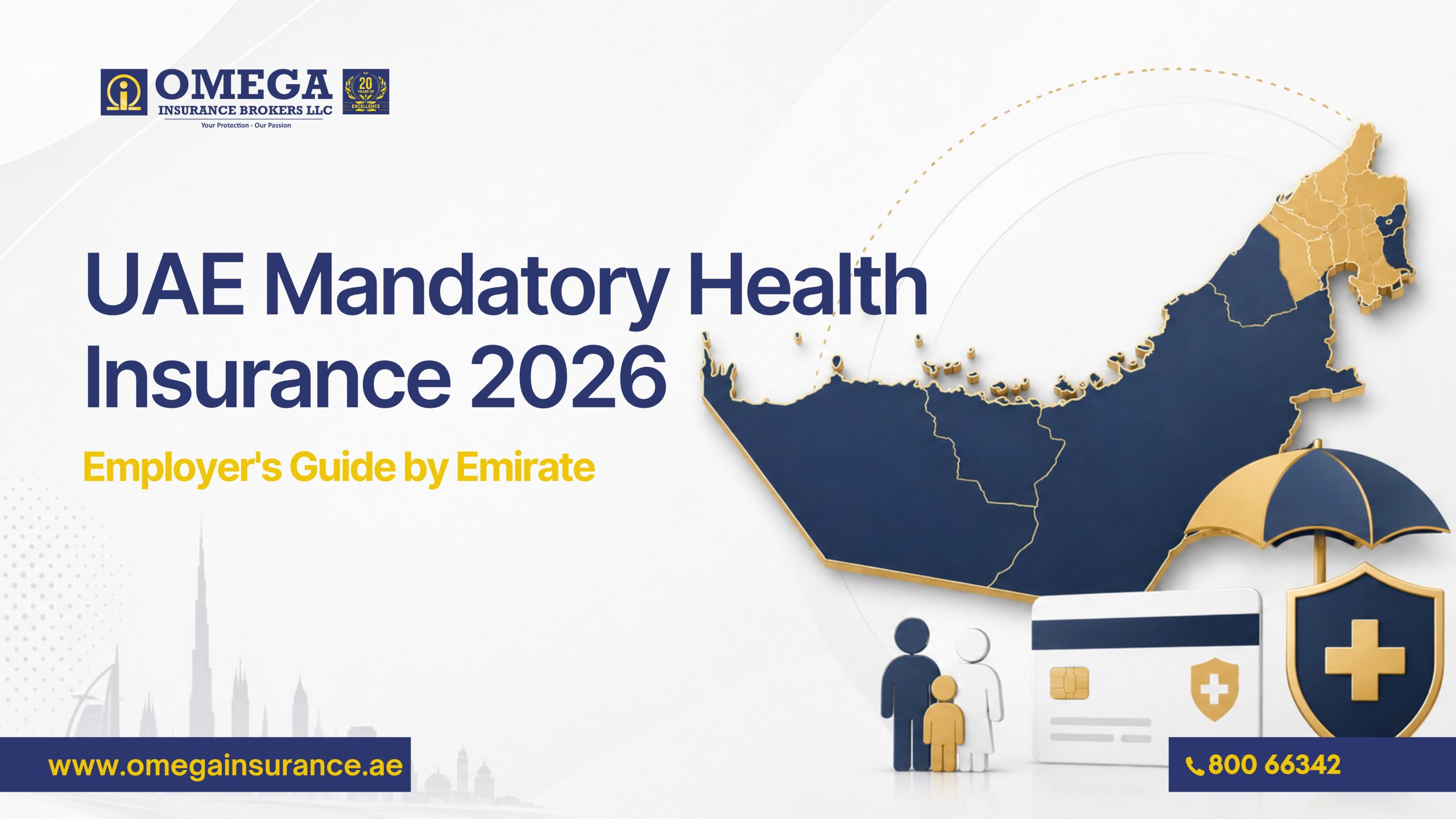
For close to two decades, only Abu Dhabi and Dubai required employers to insure their staff. That changed with a UAE Cabinet decision that took effect on 1 January 2025, extending compulsory employer-funded health cover to Sharjah, Ajman, Umm Al Quwain, Ras Al Khaimah and Fujairah. For the first time, every one of the seven emirates now requires active health insurance before a residence permit can be issued or renewed.
What hasn’t changed is that each emirate still runs its own regulatory framework. Dubai answers to the Dubai Health Authority (DHA), Abu Dhabi to the Department of Health (DoH), and the five Northern Emirates to the Ministry of Health and Prevention (MOHAP) at the federal level. An employer with staff spread across two or three emirates is effectively juggling two or three separate compliance regimes at once.
Dubai: The Longest-Standing Regime
Dubai’s employer mandate dates back to DHA Law No. 11 of 2013, rolled out in phases from 2014 and now covering businesses of every size. Employers must provide cover for every employee, and in many cases for their dependents too. The DHA sets a minimum benefits package (commonly referred to as the EBP) that any compliant policy must meet or exceed, covering inpatient, outpatient, emergency and specialist care. Because Dubai has run this system the longest, its enforcement is the most mature — immigration checks, renewal reminders and fine structures are well established.
Abu Dhabi: Widest Dependent Coverage
Abu Dhabi has required employer-funded insurance even longer, since Law No. 23 of 2005, administered by the Department of Health. The distinctive feature here is scope: sponsors are typically required to insure not just the employee but also the spouse and up to three children under 18 and, in some cases, parents. Employers hiring in Abu Dhabi should budget for this broader dependent obligation from the outset rather than discovering it at renewal time.
Sharjah, Ajman, Umm Al Quwain, Ras Al Khaimah and Fujairah: The New Frontier
Under the 2025 Cabinet decision, MOHAP now requires private-sector employers in these five emirates to insure every employee and domestic worker before residence permits are processed. Because the requirement is newer here, minimum benefit packages tend to sit at the lower end of the market — entry-level plans can start from a few hundred dirhams per person annually — but the compliance consequence for skipping cover is identical to Dubai or Abu Dhabi: a blocked or rejected visa application.
What Every Employer Must Get Right
- Coverage must come from a UAE-licensed insurer and meet the applicable emirate’s minimum benefit package — inpatient, outpatient, emergency and specialist care at minimum.
- Domestic workers sponsored by the company or by individual staff members must also be insured; this is frequently missed.
- Dependent obligations differ by emirate — confirm what applies before assuming a Dubai-style policy suffices in Abu Dhabi.
- Policies must be active before ICP or GDRFA will issue or renew a residence visa; a lapsed policy can delay an entire batch of renewals.
- Non-compliance carries real financial risk. Reported fines range from roughly AED 500 up to AED 150,000 depending on the emirate and the nature of the breach, on top of visa processing delays and possible labour card suspension.
A Simple Compliance Checklist
Before your next visa cycle, it is worth mapping every employee against their emirate of residence, confirming which regulator applies, and checking that current policies meet that emirate’s minimum benefit and dependent rules. Renewal dates should be tracked centrally rather than left to individual departments — this is usually where gaps like Fatima’s first appear.
The Bottom Line
Mandatory health insurance in the UAE is now a genuinely nationwide obligation, but “nationwide” does not mean “uniform.” Employers who treat it as a single, one-size policy exercise are the ones most likely to hit a rejected visa application or an unexpected fine. Understanding the regulator, the minimum benefit level and the dependent rules in each emirate where you employ staff is the difference between smooth visa renewals and costly delays.