
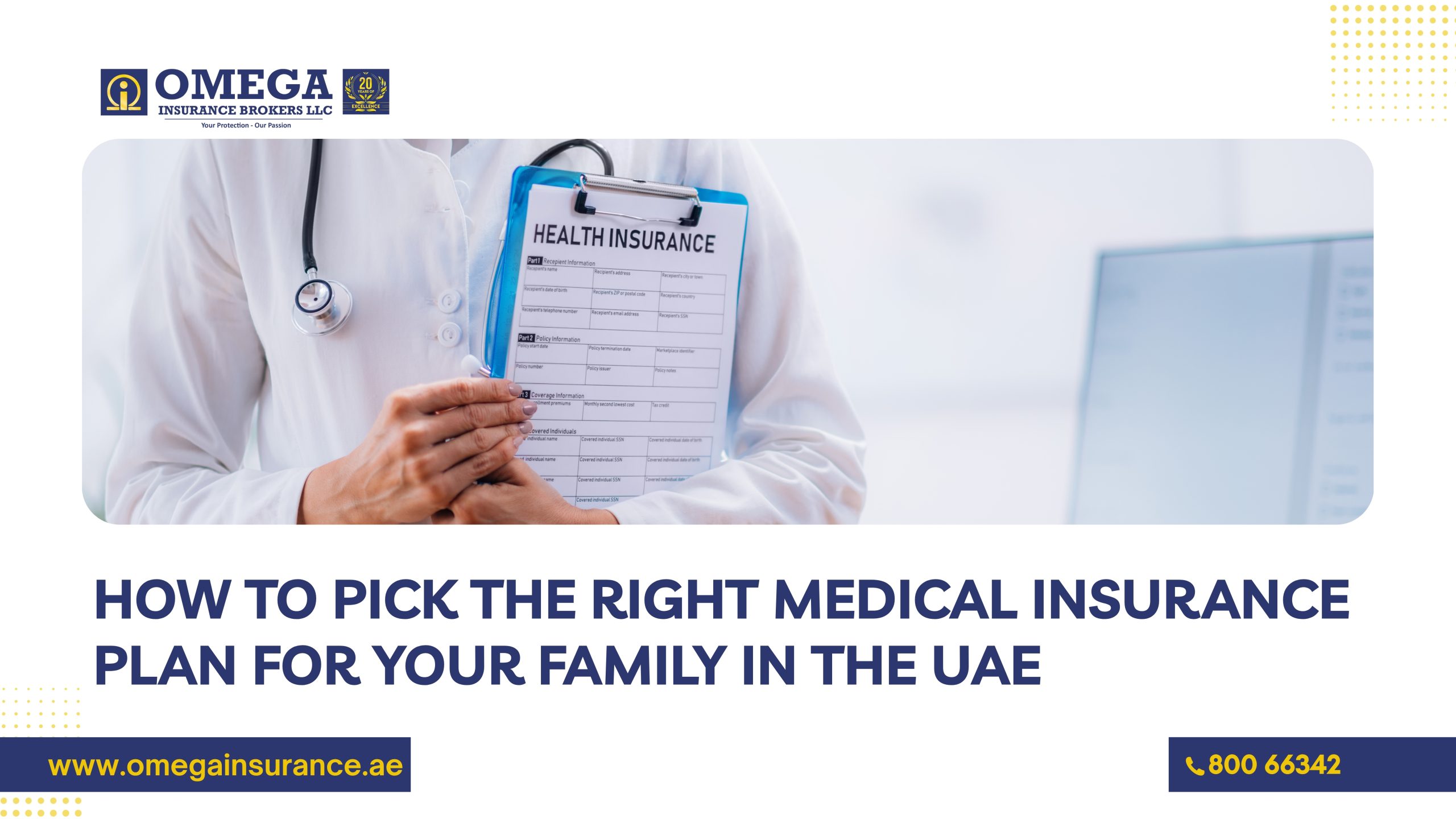
Choosing a medical insurance plan for yourself is one thing. Choosing the right plan for your entire family — your spouse, children, maybe an elderly parent — is a different challenge altogether.
In the UAE, where healthcare costs can be significant and the insurance market is crowded with options, making the wrong choice can mean either paying far more than you should, or finding yourself underinsured at exactly the wrong moment.
This guide walks you through everything you need to consider when picking a family medical insurance plan in the UAE — from understanding what’s mandatory to knowing which benefits actually matter.
Step 1: Understand Who Needs to Be Covered
Before you compare a single plan, get clear on exactly who you’re insuring. In the UAE, family health insurance typically covers:
- Primary policyholder (the employee or plan holder)
- Spouse
- Children (most plans cover children up to age 18, and some up to 25 if in full-time education)
- Domestic workers (covered separately under UAE law — your employer or household obligations may apply)
- Parents or in-laws (possible in some plans, but often at significantly higher premiums due to age-related risk)
The size and composition of your family directly affects which plan tiers are worth considering. A young couple with no children has very different needs from a family with three kids and an elderly parent living with them.
Step 2: Know What the Law Requires in Your Emirate
Health insurance regulations in the UAE are emirate-specific, and understanding your legal baseline is important.
Dubai
Under Dubai Law No. 11 of 2013, all employers must provide health insurance for their employees. Employers are also required to cover spouses and up to three children under a certain salary threshold. The DHA Essential Benefits Plan (EBP) sets the minimum coverage standard.
Abu Dhabi
Abu Dhabi has one of the most comprehensive mandatory schemes in the region. Under the DOH (formerly HAAD) framework, health insurance is mandatory for employees, spouses, and children. The Thiqa scheme covers UAE nationals, while expatriates are covered through private insurance under the ADNIC-administered Daman or equivalent plans.
Northern Emirates
The federal MOHAP framework applies to Sharjah, Ajman, Ras Al Khaimah, Fujairah, and Umm Al Quwain. Mandatory health insurance for employees is required, but the coverage standards and enforcement vary more than in Dubai and Abu Dhabi.
Key takeaway: The mandatory plan your employer provides is your legal minimum — but it may not be sufficient for your family’s actual needs. Understanding the gap between what’s required and what’s recommended is where smart planning begins.
Step 3: Assess Your Family’s Actual Healthcare Needs
This is the step most families skip — and it’s the most important one. A good insurance plan is not the most expensive or the most comprehensive on paper. It’s the one that matches your family’s real-world health usage.
Ask yourself:
- Does anyone in the family have a chronic or pre-existing condition? (Diabetes, hypertension, asthma, etc.)
- Are you planning to have children? Maternity coverage is a significant benefit that varies widely across plans.
- Do you have young children who need frequent pediatric visits, vaccinations, and dental check-ups?
- Does anyone require regular specialist consultations or ongoing medication?
- Are any family members over 60? Older dependents typically drive higher premiums and need stronger hospitalization coverage.
- What’s your family’s risk tolerance? A higher co-pay in exchange for a lower premium may work fine for a healthy family, but not for one with frequent medical needs.
Build a rough picture of your family’s likely healthcare usage over a year — GP visits, specialist visits, any planned procedures, medications — and use that as your benchmark when comparing plans.
Step 4: Understand the Key Plan Components
Health insurance plans in the UAE can look similar on the surface but differ enormously in the details. Here are the components that matter most for families:
Network of Hospitals and Clinics
The provider network determines which hospitals, clinics, and specialists you can visit without paying out of pocket. Always verify:
- Is your preferred hospital or family doctor in the network?
- Are there reputable pediatric clinics and maternity hospitals in the network?
- For specialist referrals, does the network include tertiary care hospitals in Dubai or Abu Dhabi?
A plan with a broader network costs more but gives you far greater flexibility — especially important when you have children who may need urgent or specialist care.
In-Patient vs. Out-Patient Coverage
- In-patient (IP) coverage applies when a family member is admitted to hospital for treatment or surgery.
- Out-patient (OP) coverage applies to GP visits, specialist consultations, diagnostics, and prescription medications — which is where most families actually spend their healthcare budget day-to-day.
Many basic plans offer strong in-patient coverage but limit out-patient benefits. For families with children and regular healthcare needs, a plan with robust out-patient benefits is often more valuable.
Maternity Coverage
If you are planning to grow your family, this is non-negotiable. Look closely at:
- Waiting period — most plans have a 9 to 12-month waiting period before maternity claims are accepted
- Coverage limits — normal delivery, C-section, and complications each may have separate sub-limits
- New-born coverage — does the plan automatically cover the baby from birth, and for how long?
- Pre-natal and post-natal visits — are these included in the maternity benefit or counted against your out-patient limit?
A maternity sub-limit of AED 10,000 sounds adequate until you factor in a C-section in a Dubai private hospital, which can easily exceed AED 20,000–30,000.
Pediatric and Preventive Care
For families with children, check whether the plan covers:
- Well-baby visits and developmental check-ups
- Mandatory and recommended vaccinations
- Pediatric dental coverage (often excluded or sub-limited)
- Orthodontic treatment (generally excluded from basic plans)
Dental and Optical Benefits
Adult dental and optical coverage is frequently excluded from the essential benefits plan and offered only as an add-on or in enhanced plans. If your family relies on glasses, contact lenses, or regular dental care, factor the cost of these add-ons into your comparison.
Mental Health Coverage
Mental health awareness is growing across the UAE, and more insurers are now offering meaningful mental health benefits — including therapy sessions, psychiatry consultations, and inpatient psychiatric care. If any family member may benefit from mental health support, verify the scope of this benefit carefully.
Geographic Coverage
This matters more than many families realise. Key questions:
- Is the plan UAE-only, or does it include GCC-wide coverage?
- If you travel frequently as a family or have children studying abroad, does the plan include international emergency cover?
- Is there a repatriation benefit in the event of a serious medical emergency?
Step 5: Compare Costs Beyond the Premium
The premium — the monthly or annual amount you pay for the plan — is just one part of the total cost. When comparing family plans, look at all of the following:
| Cost Component | What It Means |
| Premium | What you pay to hold the policy |
| Co-insurance / Co-pay | Your share of each claim (e.g., 20% of the bill) |
| Deductible | A fixed amount you pay before coverage kicks in |
| Sub-limits | Maximum the insurer pays per condition or benefit |
| Out-of-pocket maximum | The cap on what you pay in a year before the insurer covers 100% |
A family plan with a low premium but high co-insurance and low sub-limits can end up costing significantly more in real terms than a slightly pricier plan with better terms.
Example: A plan charging AED 4,000/year per family member with a 20% co-insurance and AED 10,000 maternity sub-limit may leave you paying AED 8,000–15,000 out of pocket for a delivery. A plan at AED 5,500/year with 10% co-insurance and AED 25,000 maternity benefit could save you considerably more in practice.
Step 6: Check Insurer Service Quality
Price and benefits matter — but so does the claims experience. When a family member is unwell, the last thing you want is to battle an insurer over approval. Before committing to a plan, consider:
- Pre-authorisation process — how easy is it to get approval for specialist visits, diagnostics, and elective procedures?
- Claims turnaround — how quickly does the insurer reimburse if you pay out of pocket?
- Customer service — is there a 24/7 helpline? Is there a dedicated app or portal for claims tracking?
- Insurer reputation in the UAE market — work with a broker who knows which insurers consistently deliver and which ones have a track record of disputes
At Omega Insurance Brokers, we work with all major insurers in the UAE market and can give you a frank, unbiased view of which companies are easiest to work with when it matters.
Step 7: Review and Renew Annually
Your family’s circumstances change — a new baby, a change in jobs, a family member’s new diagnosis, children aging out of the plan. Health insurance is not a set-and-forget decision.
Review your family’s plan at least 60 to 90 days before renewal each year. This gives you time to:
- Compare the market for better options
- Negotiate with your current insurer from a position of strength
- Make any required medical declarations before the new policy period begins
- Avoid gaps in coverage during transitions
Common Mistakes Families Make When Choosing Health Insurance in the UAE
- Choosing the cheapest plan without reading the sub-limits — only to find key benefits like maternity or specialist care are capped too low to be useful
- Not checking if preferred hospitals are in-network — leading to unexpected out-of-pocket costs
- Forgetting to add dependents on time — late additions may trigger new waiting periods
- Assuming the employer’s plan is sufficient — for families with specific needs, it often isn’t
- Not disclosing pre-existing conditions — this can void claims and even the entire policy
- Skipping the annual review — missing better deals or failing to upgrade as family needs grow
Frequently Asked Questions
Q: Can I add my parents to my UAE family health insurance plan?
Some insurers allow you to add parents as dependents, but premiums for older adults are substantially higher. In many cases, a separate individual plan for parents may be more cost-effective. A broker can help you compare.
Q: What’s the best age to add a new-born to health insurance in the UAE?
Most plans require you to add a new-born within 30 days of birth to ensure continuous coverage. Failing to do so may result in the child being treated as a new applicant, potentially subject to a waiting period.
Q: Is dental and optical coverage included in UAE family health insurance?
Not usually in basic or essential benefits plans. Dental and optical coverage are typically available as add-ons or within enhanced plan tiers. Always confirm before assuming these are included.
Q: What if my employer’s plan doesn’t cover my spouse or children?
You can purchase a supplementary individual or family plan to cover dependents not included in your employer’s group policy. This is very common in the UAE.
Q: How do I know if a hospital is in my insurance network?
Your insurer’s website or app should have a searchable network directory. Your broker can also verify this for you before you purchase the plan.
Final Thoughts
Choosing the right medical insurance for your family in the UAE is one of the most important financial decisions you’ll make as a household. It’s not just about compliance — it’s about making sure that when your family needs healthcare, you’re not caught off guard by gaps in coverage or unexpected costs.
The right plan depends on your family’s size, health profile, budget, and lifestyle. There is no universal answer — but there is always a right answer for you, and finding it requires comparing the market with the right guidance.
At Omega Insurance Brokers LLC, we take the complexity out of the process. We assess your family’s needs, compare plans across the UAE’s leading insurers, explain the fine print in plain language, and help you make a decision you’re confident in — not one you regret.
Get in touch with Omega Insurance Brokers today for a free family health insurance consultation and a no-obligation quote tailored to your specific situation.
“This article is for informational purposes only and does not constitute legal or financial advice. Insurance terms, regulations, and pricing are subject to change. Consult a licensed insurance broker for personalised guidance.“